Author's Note: This is also published in Angles 2023, a publication of selected essays from introductory writing subjects at MIT.
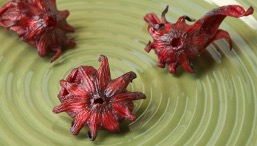
In one swift movement, I tear open the package and peer inside. Are those… demogorgon heads from Stranger Things? The contents are stunning; they are rose-colored, fully intact dried flowers. As I pop one into my mouth, I cannot fathom the fact that I am introducing flowers to my diet. But their taste halts my naive chew: hold on now, where have I tasted this flavor before? Why does it feel like it has been a lifetime since then?
This taste suddenly transports me back to over a decade ago. At seven years old, I was already searching for solace. Between starting at a new school every year, moving houses nearly just as often, and constantly overhearing my parents argue left and right, it sometimes felt like I was caught in the swirl of a hurricane. Indulging in Asian snacks provided a modest but reliable escape.
On one of many routine trips to Four Seasons, our local Asian mart in Virginia Beach, I first spotted those pink, paper-wrapped cylinders; they almost looked like confetti party poppers. Unlike the other snacks on the shelf, these did not tout anything particularly alluring on their packaging. There was no staged photo of the treat inside, no convincing nutritional facts, no enticing flavor description. This treat was simply labeled with two English words amidst a bit of Chinese text: HAW FLAKES. Ironically, I knew I had to try it immediately.
That evening, after we got home from shopping, my brother and I piled up our restocked snack stash in the middle of his room. It was a common occurrence for us to judge new, niche snacks with utmost seriousness and critique. Sitting on the bare carpet, we sampled shrimp chips with new and updated flavors, tore open pre-packaged cracker rolls made with unrecognizable ingredients, and devoured hard candies that claimed flavors of fruits we had never tried.
When I finally reach for the Haw Flakes, I tear open the two layers of paper packaging, a process I later come to perfect, and pop a reddish-pink disc in my mouth. It is unexpected, the first bite of tartness. The flake sits solidly on my tongue for just a few seconds before it dissolves easily, cracking and melting into sweetness. It is not love at first sight or first bite. It takes a few of them to convince me of their superior status among all my snacks. But eventually, Haw Flakes become engraved in the list of foods I love, foods with flavors that will always transport me to beloved moments in my life.
My safe haven from the constant change in my life was my stash of peculiar snacks. Barely knowing what “haw” even referred to, I subconsciously subsisted on Haw Flakes and other Asian treats for the better part of four or five years. Nothing needed to change about them: they were easily pocketable, they had the ideal balance of tart and sweet, and a couple flakes were just enough to satisfy me when I wanted to sneak a taste. My taste buds had been searching for something that would remind me of the comfort of home amidst the isolation of being “the new kid” at school. Haw Flakes fit the criteria perfectly.
The regularity of going to Asian marts followed me around the country for most of my childhood. Regardless of where my family settled, my mom always searched near and far for a staple Asian store. After all, from where else could we even begin to find key ingredients for soul-filling foods? Hauling home giant bags of rice was a frequent occurrence, in addition to gallon-sized cartons of soy sauce, sesame oil and various other ingredients, whose identities were lost to me in the Chinese to English translation. As I grew older, I began to live in cities that seemed more and more urban; the suburbs of Virginia Beach, Virginia turned into the bustling hub-bub culture of Flushing and Westbury, New York. The responsibility fell onto me to hand carry our goods back home, no longer shoving groceries in the back trunk of our car, but making the slow trek down busy sidewalks with heavy bags digging into my shoulders.
As my brother and I became attuned to American culture, our Asian grocery trips grew more sparse. My brother, seven years my elder, had a particularly picky palate. Going into high school, he had somehow convinced my mom to pack him the same lunch every day. It consisted of one thing: Nutella sandwiches. Make no mistake – the “recipe” calls for simply a heaping of Nutella sandwiched in between two pieces of white bread, wrapped in hard-to-unravel Saran wrap. Nutella is not an easily accessible ingredient at the Asian store. As for me, I wanted so badly to fit in at grade school. My classmates did not pack things like Haw Flakes or zong zi; they packed Lunchables, Scooby-Doo gummy snacks, and Ritz crackers. I hated when the smells (albeit delicious) wafted from my thermos to another lunch table. This is why I pleaded to switch to cold lunches, with deli meats and snack brands that others recognized. My brother and I influenced my mom to shop at stores like Whole Foods and Giant, big American supermarket chains with few “cultural” aisles, where most ethnic cultures were lumped together side by side. My rice-cooker-like pot of Things That Concerned Me was already full to the brim with social, familial, and academic anxieties; there was no room for maintaining pride in my Chinese culture.
As I look back, it pains me that my mom had no way to interfere nor keep up with our Americanization: the way our English skills surpassed our Mandarin ones, by and by, or our comestible cravings tending towards American flavor profiles. Every time parent-teacher day came around, I would be stuck at home, imagining the worst scenarios my mom could be facing with her limited English. Moreover, she was never convinced that the box lunches we requested had sufficient nutrition, but prepared them reluctantly, knowing they would satiate us. She knew that it was the beginning of the cultural divide between her generation and ours: a divide that would span food, language, and values.
To me, as a child of immigrants, the basis of Chinese culture was its food. Traditions like zhong qu jie (Mid-Autumn Festival) and dong zhi jie (Winter Solstice Festival) were defined in my mind as “mooncake day” and “tang yuan (sweet glutinous rice balls) day.” The only thing differentiating Chinese New Year from the calendar new year was the incredible quantity and quality of culturally-significant dishes my parents created. But year after year, I enjoyed the dishes at surface level; I never really appreciated the significance of our Chinese heritage nor had the motivation to give it that much more thought. Unbeknownst to me, Haw Flakes, along with their gold paper packaging that I ripped into neat spirals, would slowly become inched out of my life. It seemed to happen slowly, then all at once.
It was not until I was in high school that I began to come around to the beauty of my culture and identity. I relished the opportunities I got to eat and pack my mom’s homemade food for school lunches and realized how silly it was to be embarrassed about it. The thermoses of fragrant beef and veggies were something that made me stand out, but in a way that I was proud of. Even further, my food became something that I was proud to introduce to my curious and respectful classmates.
Fast forward; it is September 2021 and I am 17 years old. I find myself on vacation in California. My love for the quirky American grocery chain Trader Joe’s is raging harder than ever, so when a TJ’s run is suggested, I say “yes!” with no hesitation. No matter the cloudy, hazy weather; my day is brightened with a visit to the niche nooks and crannies of this delightful store anywhere in the country.
I stroll past the produce section, the meat and cheeses, the dairy and eggs. I am hunting for a reliable road trip snack. The dried fruit aisle hosts colorful packages of common fruits, as well as inconspicuous packages of dried hibiscus flowers. I am not inclined to purchase them, but they end up tossed into our cart anyway. I am thinking, what is the harm in trying something new? As we exit the parking garage, those flowers are the first thing I fumble around for.
I am shocked at the taste; it is perfectly tart and sweet. The flavor is on the tip of my tongue, literally, but I can not put a finger on it. Inching forward in California traffic, amidst the honks and revs, it finally comes to me. These dried hibiscus flowers have a flavor profile just like the good old Haw Flakes of back in the day.
I am honestly taken aback. How can something marketed in Trader Joe’s be reminiscent of this otherworldly flavor I could only find in the depths of my local Four Seasons? Was it legitimate to have such an emotional, culturally-nostalgic reaction to something that was packaged in an American way? I felt incredulous that my niche Haw Flakes, like dozens of other snacks, could be subject to becoming Americanized too – not unlike myself.
I felt incredulous that my niche Haw Flakes, like dozens of other snacks, could be subject to becoming Americanized too – not unlike myself. At the end of the day, (or rather, the package) I realized that I could not have cared less. This “Americanization” would simply be a concern for another day. I was busy savoring the nostalgia that only this flavor could have brought me.
I am no longer seven years old, relying on a snack to carry me through being “the new kid,” or to remind me of my cultural roots. The last time I was the new kid was recent, being 11th grade, but I went through it unphased, bringing the tastiest ethnic foods to lunch with no care for others’ reactions. I cannot imagine ever asking my mom for a deli sandwich or salad instead of her delectable homemade fried rice or handmade dumplings. I have come to realize how much I cherish my Chinese culture: I have new motivation to become fluent in Mandarin for better communication with relatives, and I want to observe traditions like joyous Chinese New Year and solemn after-death rituals to ensure they’re introduced to future generations.
Now, Haw Flakes, and by extension, hibiscus flowers, serve as a comfort food. Such monumental memories of mine are imprinted with this flavor: just one bite and I am reminded of my coming-of-age. Though my naivety may be unchanged from the time I first tasted this at seven, I am proud of the person I have grown into.
Works Cited
Allen, Emily. “Edible Flowers.” Flickr, 1 Dec 2008, flickr.com/photos/empracht/3099322074/.